
Reporter Takes You to the Forum (III): Hydrogen Powers the Future! A Roundtable Discusses Carbon Neutrality, the Hydrogen Economy, and New Growth Drivers.
Release Date:
2022-09-06
Roundtable Discussion
At the 2022 Hydrogen Economy Development Forum held on September 3, the roundtable discussion—centered on the theme “Carbon Neutrality, Hydrogen Economy, New Momentum”—served as the forum’s culminating session. Moderated by Lu Yuebing, Chairman of the Board of Air Liquide (China), the dialogue began by highlighting the pressing need for innovative breakthroughs as Shanxi’s hydrogen industry transitions from its early stages toward large-scale deployment. The moderator posed the question: “How can we help Shanxi firmly advance its hydrogen strategy and address existing technological gaps?” Chairman Zheng Peng’s insightful remarks resonated deeply with the audience—comprising government leaders, experts, and representatives from various media outlets—and were met with enthusiastic applause.
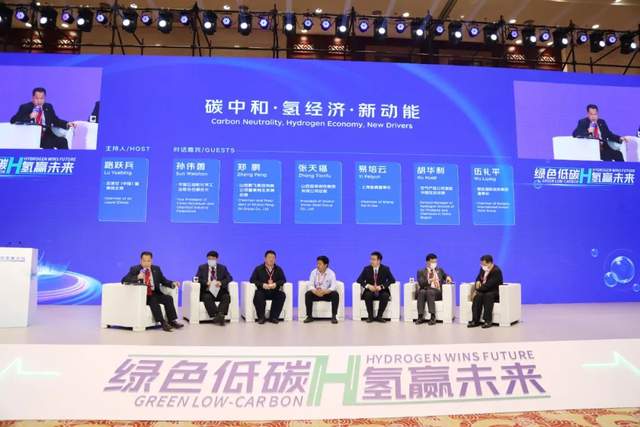
During the roundtable discussion, Chairman Zheng Peng took his seat on stage alongside Sun Weishan, Vice President of the China Petroleum and Chemical Industry Federation; Zhang Tianfu, President of Shanxi Jinnan Iron & Steel Group Co., Ltd.; Yi Peiyun, Chairman of Shanghai Hydrogen Morning; Hu Huali, General Manager of Air Products’ Hydrogen Business in China; and Wu Liping, Chairman of Rongwu International Investment Group—leading experts and industry leaders from across the hydrogen‑energy value chain. Together, they exchanged insights on hydrogen‑energy technologies and expressed strong optimism and confidence that Shanxi will soon achieve large‑scale development of its hydrogen economy.
First round of questions
During the first round of questions, Lu Yuebing asked the guests how to help Shanxi’s hydrogen energy industry move beyond its early stages and scale up.
Lu Yuebing: Hydrogen energy is a promising, large-scale industry. How can we help Shanxi’s hydrogen sector move beyond its early stages and scale up?
Sun Weishan: Confident in helping Shanxi’s hydrogen energy sector achieve large-scale development.
Zheng Peng: Leveraging the industrial strengths of Lüliang and Xiaoyi, we will expand the utilization of abundant hydrogen across various sectors, thereby improving quality of life and extending lifespans.
Zhang Tianfu: Hydrogen energy applications are multifaceted, with efforts focused on the steel industry, heavy-duty trucks, hydrogen refueling stations, and talent recruitment.
Yi Peiyun: Technological breakthroughs have already been achieved, and the pace is rapid; Shanxi will soon be the first to complete it.
Hu Huali: Carbon neutrality is a global environmental trend, and scaling up is inevitable.
Wu Liping: Hydrogen energy holds great promise and significant investment potential.
Second-round questions
Based on the current state of hydrogen energy development in Shanxi, the province simultaneously boasts a clear energy‑resource advantage and faces significant shortcomings in technological innovation. During the second round of questions, Lu Yuebing posed specific inquiries to the panelists on how to effectively leverage scientific research and enterprises’ core strengths to advance Shanxi’s hydrogen‑energy sector.
Lu Yuebing: Based on Shanxi’s current situation, how can hydrogen energy be developed in a way that prioritizes establishment before dismantling?
Sun Weishan: In the transition to coal‑based development, leveraging coke oven gas is an advantage. However, policy measures remain insufficiently detailed; there are no hydrogen‑energy standards to provide guidance; technological breakthroughs—particularly in storage and transportation—are still needed; public awareness of hydrogen‑energy development must be enhanced; and proactive education on safe and proper usage is also required.
Lu Yuebing: Pengfei Group’s transformation of its traditional energy sector demonstrates both courage and wisdom. How can the two key transitions—shifting from coal and coke to hydrogen energy, and pivoting from resource‑based operations to technology‑driven manufacturing—be successfully navigated?
Zheng Peng: Starting with low‑carbon and zero‑carbon emissions, our reliance on coal remains unchanged; what has changed is the way we use it—shifting from polluting, inefficient practices to cleaner, more sustainable ones. We’ve reduced pollution by promoting the green utilization of clean coke‑oven gas, which in turn enables hydrogen production. This has opened up an even larger industry: hydrogen is the future, and it represents one of the most competitive sectors worldwide. Our main weakness lies in technology. By inviting Academician Lin and Dr. Huang to help address this gap, we’re leveraging our resource advantages to build technological strength, and within less than a year, we’ve already seen significant results. Yesterday, the world’s first 250‑kilowatt fuel‑cell platform‑scale single‑stack system was unveiled at Pengfei—this is the fruit of a powerful collaboration. Companies have long struggled due to shortcomings in science and technology; that’s why we’ve brought top talent to Lüliang and Xiaoyi, aiming to establish a globally competitive hydrogen‑energy industry and committing ourselves to making a meaningful contribution to human society.
Lu Yuebing: How can we leverage the R&D strengths of fuel cells to address Shanxi’s technological shortcomings?
Yi Peiyun: The R&D of fuel cell stacks can be summed up in three words: large, small, and low—higher power, smaller footprint, and lower costs. Only by accelerating commercialization and driving down hydrogen prices can we achieve this. Shanxi needs to leverage technological and industrial innovation to swiftly break free from cost constraints.
Lu Yuebing: What are the global strategies for low-carbon development?
Hu Huali: Our three major strategies are low‑carbon development, new energy, and carbon capture. In the hydrogen sector, we provide end‑to‑end solutions—covering research and development in production, storage, transportation, and refueling—for both low‑carbon and zero‑carbon hydrogen projects. Reducing hydrogen costs hinges on introducing advanced hydrogen‑transport technologies to China, thereby lowering logistics expenses, while simultaneously advancing commercial‑scale technologies for liquid‑hydrogen transport and liquid‑hydrogen refueling stations.
Lu Yuebing: What is the outlook for hydrogen energy investment?
Wu Liping: Viewing hydrogen energy through the lens of capital, we establish industry‑focused funds that engage with governments, empower enterprises across the value chain, and drive industrialization. This extends the supply chain, fosters a longer‑term outlook, and seamlessly integrates capital with industry.
As the first enterprise in Shanxi to establish a complete hydrogen‑related industrial chain—covering hydrogen production, storage, transportation, and utilization—and to expand applications into fuel cells and heavy‑duty trucks, Chairman Zheng Peng’s remarks on topics such as “hydrogen at 8 yuan per kilogram,” “a hydrogen‑refueling station network in Lüliang,” “the manufacture of hydrogen‑powered heavy trucks,” and a “250‑kilowatt hydrogen fuel cell system” quickly sparked widespread discussion. During the exchange, several guests repeatedly highlighted Pengfei Group, expressing deep admiration for its courage and vision in transforming traditional industries to become a leading enterprise in Shanxi, while also reinforcing their confidence in the future of hydrogen energy development.
Lu Yuebing: Hydrogen energy enjoys distinct advantages in China, particularly in Shanxi Province. First, favorable policies for hydrogen production, the government’s proactive stance in developing emerging industries, and strong innovation capacity all constitute unique strengths. Second, whether in coal‑chemicals or hydrogen itself, abundant resources are readily available. Third, there are numerous application scenarios, spanning steel, petrochemicals, port logistics, and more. Fourth, China leads the world in the deployment of trucks, buses, and commercial vehicles. With these key advantages, hydrogen energy is poised to become another globally competitive industry in China—following solar and wind power—and will contribute to both the energy and industrial transitions, as well as to human progress.
Related News

Address: Intersection of Zhenxing Street and Zhonghe Road, Xiaoyi City, Shanxi Province

Mobile version of the website

Official WeChat Public Account
